


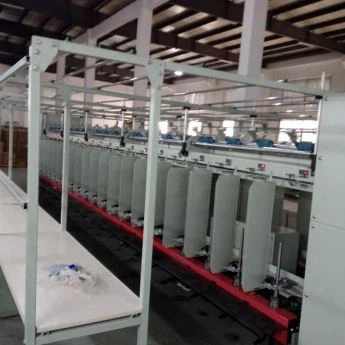
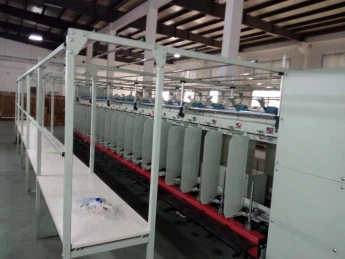
Single Thread Twisting Machine
Product Description
DT2008Single spindle machine
Single Thread Twisting Machine
The product uses MITUSBISHI inverter control,automatic twist conversion,CNC forming and 1kg-15kg roll with out knots.It can be appliedin the combination and twisting for both single and multiple strands,and it’s also a new generation machine for twisting filament and industrial yarn.It can be used in various areas such as weaving industry yarn,embroidery yarn and silk ribbon industry yarn.
1) Used widely: Suitable for twisting high-frequency wire, data wire, electronic wire and etc.
2) High productivity: high rotate speed, the production efficiency is 2 times than traditional type.
3) Tension steady: take-up & wrapping tension can be constant from start to end.
4) Pitch accurate: pitch setting by touch screen & controlled by PLC, so that pitch can be constant when speed accelerating or decelerating.
5) Good traversing efficiency: traversing by moving shaft, traversing space and pitch can be adjusted according to customer's requirement.
6) Superior quality: less wire guiding wheel, product's electric property will not be damaged.


Textile industry related information
3、 Detection method:
1. Hand feeling visual measurement method: this method is suitable for textile raw materials with loose fiber state.
(1) Cotton fiber is shorter and thinner than ramie fiber and other ramie fiber and wool fiber, and is often accompanied with various impurities and defects.
(2) The hand feel of hemp fiber is rough and hard.
(3) Wool fiber is curly and elastic.
(4) Silk is a filament, long and slender, with a special luster.
(5) Among the chemical fibers, only viscose fiber has great difference in strength between dry and wet state.
(6) Spandex has great elasticity, and its length can be stretched to more than five times at room temperature.
2. According to the morphology of the fiber, the longitudinal section of the fiber is identified.
(1) Cotton fiber: cross section shape: waist round, with middle waist; longitudinal shape: flat belt, with natural curve.
(2) , ramie (ramie, flax, jute) fiber: cross section shape: waist round or polygonal, with middle cavity; longitudinal shape: with cross section and vertical grain.
(3) Wool fiber: cross section shape: round or nearly round, some have hair pulp; longitudinal shape: there are scales on the surface.
(4) Rabbit hair fiber: cross section shape: dumbbell type, with hair pulp; longitudinal shape: surface with scales.
(5) Mulberry silk fiber: cross section shape: irregular triangle; longitudinal shape: smooth and straight, longitudinal stripe.
(6) Common viscose fiber: cross section shape: zigzag, skin core structure; longitudinal shape: longitudinal groove.
(7) Rich fiber: cross section shape: less teeth, or round, oval; longitudinal shape: smooth surface.
(8) Acetate fiber: cross section shape: trilobate or irregular zigzag; longitudinal shape: longitudinal stripe on the surface.
(9) Acrylic fiber: cross section shape: round, dumbbell shaped or leafy; longitudinal shape: smooth or striped surface.
(10) The cross-section shape of the fiber is close to circular; the longitudinal shape is smooth.
(11) Spandex fiber: cross section shape: irregular shape, round and potato shape; longitudinal shape: dark and deep surface, unclear bone shaped stripes.
(12) , polyester, nylon, polypropylene fiber: cross section shape: round or irregular shape; longitudinal shape: smooth.
(13) Vinylon fiber: cross section shape: waist round, skin core structure; longitudinal shape: 1 ~ 2 grooves.
3. Density gradient method: it is based on the characteristics of various fibers with different densities to identify fibers.
(1) The system of xylene carbon tetrachloride is generally used.
(2) The precision ball method is commonly used to calibrate the density gradient tube.
(3) After being put into balance, the fiber density was measured according to the fiber suspension position.
4. Fluorescence method: ultraviolet fluorescent lamp is used to irradiate the fiber. According to the different luminescent properties of various fibers, the fluorescence color of the fiber is also different to identify the fiber.
The fluorescent colors of various fibers are as follows:
(1) , cotton, wool fiber: light yellow
(2) Mercerized cotton fiber: light red
(3) Jute fiber: purple brown
(4) Jute, silk, nylon fiber: light blue
(5) Viscose fiber: white purple shadow
(6) Bright viscose fiber: light yellow and purple shadow
(7) Polyester fiber: white light, blue sky light is very bright
(8) Vinylon lustrous fiber: light yellow purple shadow.
5. Combustion method: according to the chemical composition of the fiber, the combustion characteristics are also different, so as to roughly distinguish the major types of fiber.
The combustion characteristics of several common fibers are compared as follows:
(1) , cotton, hemp, viscose fiber, cuprammonia fiber: close to the flame: no shrinkage and no melting; contact with the flame: rapid combustion; leave the flame: continue to burn; smell: the smell of burning paper; residue characteristics: a small amount of gray black or gray white ash.
(2) , silk, wool fiber: close to the flame: curl and melt; contact with the flame: curl, melt, burn; leave the flame: slow burning, sometimes self extinguishing; odor: the smell of singed hair; residue characteristics: loose and crisp black particles or coke shape.
(3) Polyester fiber: close to the flame: melting and shrinking; contact with the flame: melting, smoking, slow combustion; leaving the flame: continuing to burn, sometimes self extinguishing; odor: special aromatic sweet taste; residue characteristics: hard black beads.
(4) Nylon fiber: close to the flame: melting and shrinking; contact with the flame: melting and smoking; leaving the flame: self extinguishing; odor: amino smell; residue characteristics: hard light brown transparent beads.
(5) Acrylic fiber: close to the flame: melt and shrink; contact with the flame: melt and smoke; leave the flame: continue to burn, emit black smoke; smell: pungent; residue characteristics: Black irregular beads, fragile.
(6) Polypropylene fiber: close to the flame: melting shrinkage; contact flame: melting, burning; leaving the flame: continuing to burn; odor: paraffin smell; residue characteristics: gray white hard transparent beads.
(7) Spandex fiber: close to the flame: melting and shrinking; contact with the flame: melting and burning; leaving the flame: self extinguishing; odor: special flavor; residue characteristics: white colloidal.
(8) Chloro fiber: close to the flame: shrinking; contact with the flame: melting, burning, emitting black smoke; leaving the flame: self extinguishing; odor: pungent smell; residue characteristics: dark brown hard block.
(9) Vinylon fiber: close to the flame: melt and shrink; contact with the flame: melt and burn; leave the flame: continue to burn, emit black smoke; smell: unique flavor; residue characteristics: irregular burnt tea hard block.
Hot Tags: Single Thread Twisting Machine, China, manufacturers, suppliers, factory
You Might Also Like



Send Inquiry