

Doubling/twisting machines combine two or more single yarns to create a stronger, more uniform, and often shinier yarn. This process enhances various yarn properties, making it suitable for a wider range of demanding applications.
II. Purpose of Doubling/Twisting Process
The primary purposes of doubling multiple single yarns are:
Increased Strength: Combining multiple single yarns significantly increases the overall strength of the yarn. If one single yarn has a weak spot, the other strands can compensate.
Improved Evenness and Consistency: By averaging out irregularities present in the individual yarns, plied yarns exhibit better evenness, fewer thick and thin areas, and fewer knots.
Reduce Hairiness: Twisting multiple yarns together typically results in a smoother yarn surface with fewer protruding fibers (less hairiness).
Increased Abrasion Resistance: The tightly twisted structure of the yarn strands makes them more resistant to abrasion, increasing their durability.
Improved Gloss and Appearance: Due to better fiber alignment and reduced hairiness, the yarn strands typically have a more uniform appearance and are sometimes even more lustrous. Special Effects: Novel yarns can be created by twisting yarns of different colors, fiber types, or twist levels.
Versatility in Increasing Diameter/Count: This allows for the production of thicker yarns with enhanced properties without having to spin very thick single yarns.
III. Working Principle: Combining and Twisting
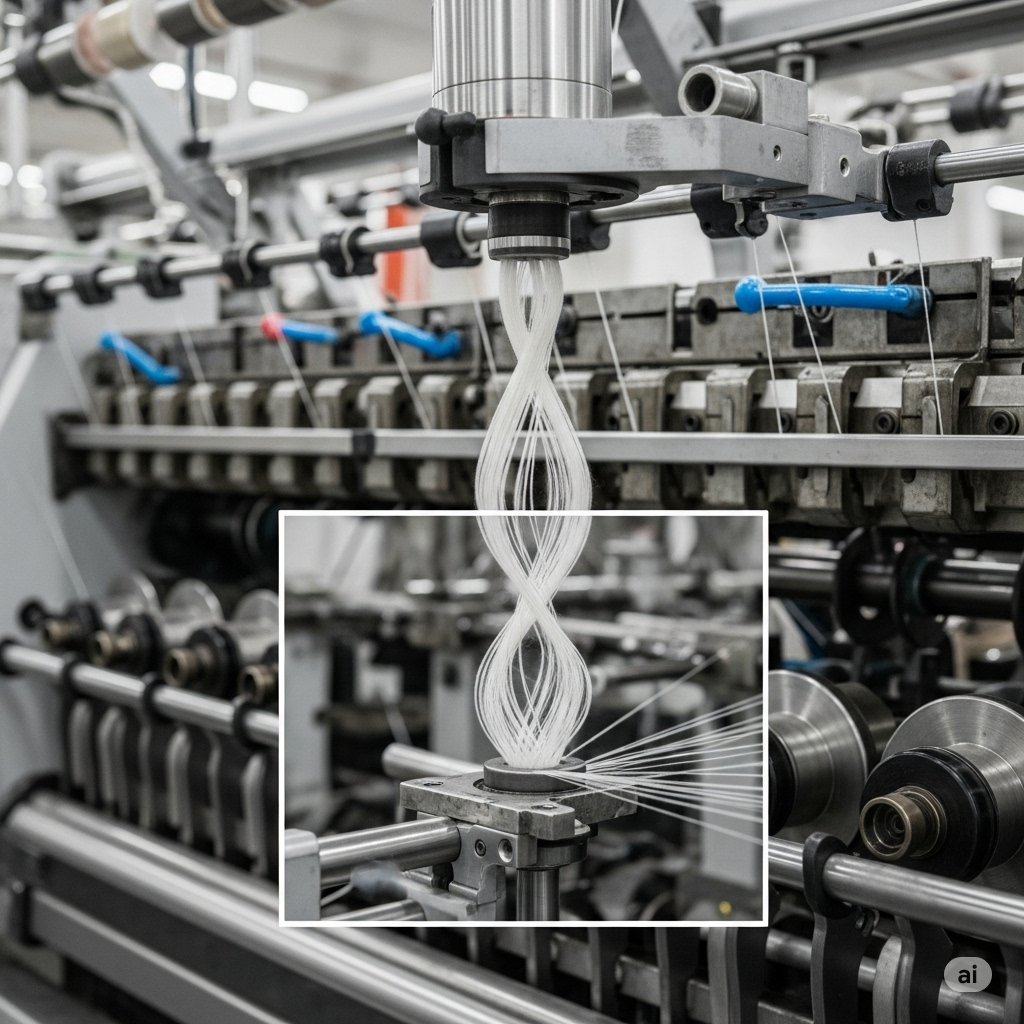
The doubling/twisting machine draws yarns from multiple cones (usually two, three, or four) and twists them together using a spindle and traveler mechanism similar to a ring spinning frame, or sometimes a two-for-one twister (TFO) twister.
Yarn Feeding: Two or more individual bobbins (wound in the previous winding stage) are mounted on the creel of each spindle position. Yarn is fed simultaneously from these bobbins.
Yarn Guiding and Tensioning: The individual yarns are guided through a tensioning device before being combined to ensure uniform tension.
Combining Point: The individual yarns are combined and guided together to form a single, untwisted composite strand. Twisting Mechanism:
Ring twister (traditional): Similar to the ring spinning frame, the combined yarn passes through a guide plate, then through a traveler on a ring, and is ultimately wound onto a bobbin on a rapidly rotating spindle. Each rotation of the traveler adds one twist to the combined yarn.
Twister (modern and popular): This is a more common and efficient method of doubling/twisting. In a twister, two twists are applied for each rotation of the spindle.
The yarn is unwound from a drum mounted in a stationary tank.
The yarn then passes through a rotating disk or flyer, which applies the primary twist as it moves from the package eye to the top of the spindle.
The yarn then travels down the hollow spindle and back to the delivery rollers, where it forms a balloon. The rotation of the entire spindle, including the twisting elements, creates the secondary twist.
The twisted yarn then passes through a delivery roller and is wound onto a winding package (conical or cylindrical). TFO twisting machines offer high productivity, producing uniform, knot-free twisted yarn.
Winding onto Winding Packages: The newly formed strands are wound onto final packages (conical or cylindrical) for further processing or dispatch.
IV. Key Features of Modern Double/Twister Machines
Twist-for-Two (TFO) technology: Widely used due to its higher productivity, lower energy consumption per unit of twist, and the ability to produce knot-free, more uniform strands.
Individual Spindle Control: Each twisting position operates independently, enabling continuous operation.
Precise Tension Control: Electronic or mechanical tensioners ensure consistent yarn tension throughout the entire process.
Automatic Stop: The machine automatically stops in the event of yarn breakage or package exhaustion, minimizing waste and facilitating operator intervention.
Digital Control: A touchscreen interface allows precise setting of twist level (turns per meter/inch), winding speed, and package density.
Energy Efficiency: Optimized motors and drives reduce power consumption, particularly in TFO twisting machines. Balloon Control: A device that controls yarn balloons during the twisting process, preventing tangles and ensuring smooth operation.
V. Advantages of Plying (Duplicate/Twist)
Enhanced Yarn Properties: Higher strength, better evenness, less hairiness, and improved abrasion resistance compared to single yarns of equivalent count.
Improved Fabric Quality: Fabrics made from plied yarns are generally stronger, more durable, have a better appearance, and a softer feel.
Better Downstream Performance: Plied yarns are less likely to break during weaving and knitting, resulting in increased machine efficiency and reduced production losses.
Versatility: Can be used to manufacture a wide range of products, from fine apparel fabrics to industrial textiles and carpets.
Value Added: Plying adds significant value to the yarn, enabling its use in high-end applications.
VI. Limitations and Considerations
Added Costs: The doubling/twisting process is an additional step in yarn production, increasing overall manufacturing costs (capital investment, energy, labor).
Energy Consumption: Twisting machines, especially ring twisters, consume a high amount of energy. TFO twisting machines are more efficient but still consume more energy.
Floor Space: Dedicated floor space is required within the spinning mill.
Noise: Operation can generate noise, so acoustic considerations need to be taken into account in mill design.
Skills Required: Operators need to be proficient in setting twist levels and monitoring yarn quality.
VII. Relevance to Lahore, Pakistan
Double-stranding/twisting machines are a vital component of many spinning mills in Lahore, particularly those producing yarn for high-quality fabrics and specialty applications.
Meeting Export Demand: A significant portion of Pakistan's textile exports, particularly high-end apparel, home textiles, and specialized industrial fabrics, require double-stranded yarn for superior performance and aesthetics.
Value-Added Products: Investment in double-stranding/twisting capabilities enables Lahore mills to produce higher-value yarns, improving profitability and market competitiveness.
Technology Adoption: Modern mills are actively investing in advanced TFO twisting machines from global manufacturers (e.g., Saurer Volkmann, Murata, and Savio) to achieve optimal efficiency and quality. Diversification: Enables mills to diversify their product portfolio beyond a single yarn to meet a wider range of customer needs.
Skills Enhancement: The operation and maintenance of these advanced machines contributes to the continuous improvement of the skills of the region's textile workforce.


