


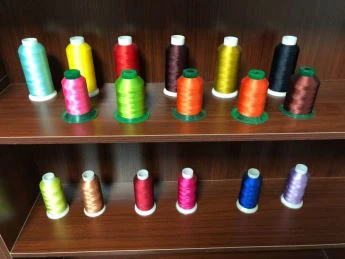
100% Rayon Or 100% Polyester Embroidery Threads
Thread Types | Denier/PLY | Applications |
Industrial polyester sewing thread | 840D/3, 1000D/3, 1500D/3, 2000D/3 | shoes, handbags, outerwear, curtains, leather goods, industrial products |
Nylon Fishing Twine | 210D/3, 210D/6, 210D/9, 210D/12, 210D/15, 210D/18, 420D/2 | Commercial fishing industry, net, Hand Knitting, Sewing, Belt, Fishing nets, Bags, etc. |
Polyester Fishing Twine | 210D/3, 210D/6, 210D/9, 210D/12, 210D/15, 210D/18, 420D/2 | Commercial fishing industry, net, Hand Knitting, Sewing, Belt, Fishing nets, Bags, etc. |
Polyester Embroidery Thread | 108D/2, 120D/2, 150D/2, 150D/3 | Garment embroidery interlining, Crochet, Cross Stitch, Embroidery, Hand Knitting, Sewing, Teabag, Weaving, etc. |
Product Name:
polyester embroidery thread
Characteristics:
Polyester embroidery thread is made of polyester filament. The thread is of good glossy effect, low friction, uniform twist, low breakage and low chromatic aberration.
Product types: 108D/2, 120D/2, 150D/2, 150D/3.
Recently, India has taken a number of emergency measures under the influence of public health emergencies. However, it never occurred to me that the development of many industries in India has also been affected by the dependence of raw materials in many industries on overseas markets. Take the textile industry for example. According to the latest media report on March 10, CMAI pointed out in a press statement that due to the delay in resumption of work by Chinese enterprises, it is expected to have an impact on the Indian textile and garment industry, which depends on the supply of Chinese raw materials.
According to the report, India buys 460 million US dollars (about 31.96 yuan) of synthetic silk from China every year, and imports over 140 million US dollars worth of accessories including buttons, zippers, hangers and needles, as well as 360 million US dollars (about 25 yuan) worth of synthetic textiles. It is reported that after discovering that it is unable to recover the previous import scale with Chinese textile manufacturers smoothly, India found that its own supply base cannot meet such a large demand for these raw materials.
Earlier, Indian garment manufacturers had thought about finding alternatives for themselves, including local procurement or expanding imports from places such as Vietnam. However, these manufacturers soon found that the above-mentioned practices would undoubtedly increase the cost of finished products by 3-5%. In addition, these suppliers may not be able to compare with Chinese suppliers in terms of delivery time, quality and cost due to the short-term transaction.
However, India has made an unexpected move even though it is worried about the development of its textile industry. According to reports, on March 4, Indian authorities issued a notice announcing the final anti-dumping decision on nylon multi filament yarn from China, South Korea and Thailand, which will charge extra fees for products from these countries.
In addition, it is worth mentioning that in addition to exporting textile products to the Indian market and adhering to the way of cooperation you come and go, China also has cotton products that come to India. However, it was reported that India's largest cotton exporter had previously announced that it would suspend cotton exports to China and turn to alternative markets such as Vietnam and Bangladesh to expand exports. Later, after Chinese enterprises proposed to buy 800000 bales of cotton, India reopened its cotton export to China.
In recent times, Cambodia's textile industry has suffered the same difficulties as India's. However, in contrast to India's efforts to gain benefits for itself, Cambodia still chooses to continue cooperation with China. After receiving the help signal from Cambodia, China has transported 63 cases of SITC full of textile raw materials to Cambodia on March 9.
Hot Tags: 100% rayon or 100% polyester embroidery threads, China, manufacturers, suppliers, factory
You Might Also Like




Send Inquiry