


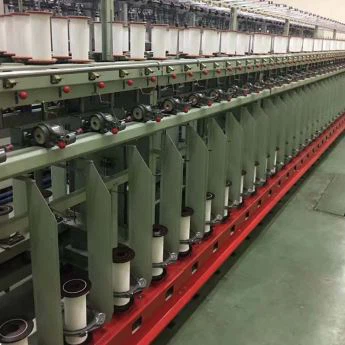
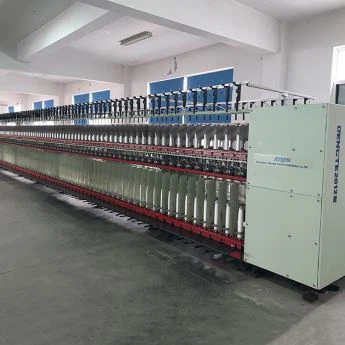
Polyester Thread Twisting Machine
As you know, in our line of work, we depend on good reports about our projects to win further business. Our clients always shop around and look for references before committing themselves. If you are interested please contact. We think if you can use our machine, it will bring you much more benefit.
DT2007 High-tech composite twisting machine owns traits such as Japanese Mitsubishi conversion control, CNC forming, high-speed imported oil bearing steel, and 1-2kg capacity ring without knot, running in a high speed etc.
Product tapes: fishing net thread, sewing thread, embroidery thread, bag&suitcase thread, zipper thread, knitting yarn, etc.
Applicable scope: Filament 50D—1000D. Polyethylene 1shares—5shares.
Plied yarn: Filament 150D--3000D. Polyethylene 3shanres--15shares.
1. The machine uses advanced electronic digital control system. Yarn package forming, yarn twist, and yarn tension will be set on the display. Take-up and traverse motion are independently driven by servo motor. Easy operation and powerful functions.
2. Take-up tension can be adjusted at will, so the soft dye package can be directly produced.
3. High steady spindle speed and lower maintenance thanks to high-quality spindle with perfect structure.
4. When braking spindle, the spindle is completely detached with tangential belt, thereby ensure a long life of them.
5. Compact structure design, small occupying space, different spindle specifications for choice.
Spindle arrangement | 2×1 | 3×1 |
Supply spindle NO. (1section) | 36 | 36 |
Ring spindle NO. (1section) | 18 | 12 |
Supply spindle NO. (10section) | 360 | 360 |
Ring spindle NO. (10section) | 180 | 120 |
Main Technical Date:
Twist range | 120 to 1250t/m, 3 to 31t/inch |
Twist direction | S or Z changeable |
Assemble ends | 3-15 |
Roller diameter | 49mm—65mm |
Ring | Φ110mm—Φ140mm |
Max.winding height | 200mm—330mm |
Spindle driving | Upper dragon belt drive and lower spindle belt drive |
Start mode | Stepless speed controlled by inverter |
Spindle speed | 2000-6000rpm |
Take-up bobbin capacity | 1kg—2kg |
Max.installed power | 11—15kw |
Overall Size | L×W×H=17.3M×1.40M×1.90M L×W×H=21.7M×1.40M×1.90M |


After many times of transfer of the global textile industry center, Southeast Asia has become the most potential area to develop the global textile and garment production base. A sudden outbreak of novel coronavirus pneumonia has pushed the development of textile and garment industry in Southeast Asia to a temporary reprieve. The retail industry of many countries in the world, the physical stores in Europe and America are closed, the sales volume of textiles and clothing has declined sharply, and the developing textile and clothing industry in Southeast Asia is in trouble.
The global textile and garment manufacturing center has a trend of transferring to Southeast Asian countries. The global textile manufacturing center has been transferred for many times. At present, Southeast Asia has the potential to grow into an important global textile and garment production base. The development of the global textile industry is in step with the industrial development process. The modern cotton textile industry originated from the British Industrial Revolution in the 18th century. At the beginning of the 20th century, the center of the global cotton textile industry was transferred to the United States. After the World War II, the global textile manufacturing center was transferred to Japan. After the 1970s, it was transferred to South Korea, Taiwan, Hong Kong and other Asian regions. Then, in the 1990s, with the increase of China's opening-up, With the rapid development of foreign trade after China's accession to WTO in 2001, China has become a global textile manufacturing center. In recent years, Southeast Asian countries have begun to undertake part of the low-end manufacturing capacity of other countries gradually due to the advantage of resource endowment in labor cost and other aspects. The textile and garment production and export trade of Southeast Asian countries are growing rapidly, and have the potential to grow into an important global textile and garment production base.
The epidemic situation pushed down the key of "postponement" for the development of textile and clothing in Southeast Asia. According to the analysis report "the impact of covid-19 on Global trade" released by the United Nations Conference on Trade and development, the global textile and garment industry will lose more than 1.5 billion US dollars (about 10.4 billion yuan), and the Southeast Asian textile and garment industry supported by export trade will be greatly affected. Due to the spread of the epidemic in Europe and the United States, many international clothing brands based in Southeast Asia have cancelled or delayed orders. VINATEX group, Vietnam's largest clothing maker, is planning to take up to 50000 workers off. According to the data of Vietnam Ministry of industry and trade, in April and may 2020, Vietnam's textile and footwear orders will drop by 70% year on year; thousands of garment factories in Bangladesh have been cancelled orders, and Bangladesh garment export promotion bureau data shows that Bangladesh's garment exports fell by more than 20% year on year in March; India's overall blockade has been extended, resulting in almost stagnation of the textile industry chain, and Indian Garment Manufacturing Association India's textile industry is likely to cut 10 million jobs, and countries such as Cambodia and Myanmar are generally under pressure in terms of production, export and employment, he said. The sharp drop of global demand makes southeast Asia textile and clothing industry in trouble.
Southeast Asian countries have introduced measures to help the garment manufacturing industry. In response to the impact of the epidemic, Southeast Asian countries have taken self-help measures. The Cambodian government stipulates that some garment manufacturing enterprises can enjoy a "tax-free period" of half a year to one year, and provide living subsidies to the unemployed workers; the Myanmar government announced the establishment of a new crown epidemic response fund of 100 billion Myanmar yuan (about 500 million yuan), which gives priority to providing support to garment processing and manufacturing industries, and before the end of this fiscal year, the export industry will not have to pay another 2% of the export prepaid income Tax to get through the crisis.
The development of Southeast Asia's textile and garment industry is facing a severe international competition environment. The global textile industry has experienced many times of transfer. Various links of the industrial chain are controlled by many countries and regions. Europe and the United States are the terminal brand retail center, while China is still the textile manufacturing center. Southeast Asian countries are mainly in the middle and low-end manufacturing links of the textile industry chain. Although the share of Southeast Asian countries' textile and garment production and export in the international market has increased rapidly in recent years, the high value-added links of their industries are weak, the dependence of raw materials and terminal markets on foreign countries is high, and they still need to face the fierce international competition situation.
The restoration of Southeast Asia's textile and garment industry needs the cooperation of global industrial chain. At present, cases in Europe are showing signs of decline. Many European countries are planning to lift some epidemic prevention and control restrictions in early May. Germany will gradually "unseal" this week. Spain, Austria, Denmark, Czech Republic and other countries have said they will relax the closure measures one after another. The decline of global demand is expected to be improved, but the epidemic accelerated the economic downward trend. The emerging economies and financial markets, including Southeast Asia, are relatively vulnerable. Under the impact of the epidemic, they are likely to become a new source of risk, with the first impact on Southeast Asia's textile and clothing industry. Therefore, it is necessary for the cotton textile and garment industry chains of all countries to cooperate and support each other to resist the negative impact of the epidemic on the global textile and garment industry.
Hot Tags: Polyester Thread Twisting Machine, China, manufacturers, suppliers, factory
You Might Also Like




Send Inquiry