

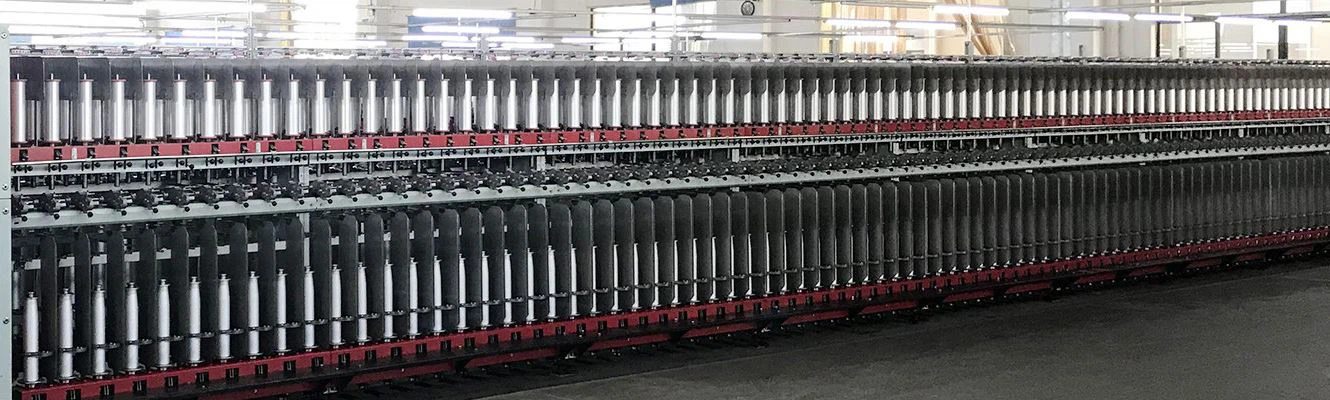


Industrial Filament Sewing Thread Ring Twister Machine
DT2005 Precision CNC Composite Twisting Machine
industrial filament sewing thread ring twister machine
The finished yarn can reach the highest international quality standards and can be produced to some high value-added products. We can also undertake various kinds of processing business such as embroidery thread, knitting yarn, zipper, luggage lines etc according to clients’ requirement. If you need some kind of thread and yarns, not machine, you can also call us and tell us you requirements about thread or yarns and we will produce it in accordance with your demand.industrial filament sewing thread ring twister machine
High Quality Yarn
Winch roller driven by single spindle, more accurate yarn twist, no external force extrusion, more rounded cross section;
Display of computer tracking on spindle speed, ensure accuracy of both initial and compound twist;
No oil imported materials of high speed steel making, less breakage;
NC constant tension winding, ensure constant thread speed, volume weight up to 1.6kg.
Ply Count Range:
2×1: 50D—500D
3×1: 50D—1000D
Products apply for sewing, embroidery, bonded thread.
industrial filament sewing thread ring twister machine
Spindle arrangement | 2×1 | 3×1 | |
Supply spindle NO. (1section) | 36 | 40 | 36 |
Ring spindle NO. (1section) | 18 | 20 | 12 |
Supply spindle NO. (10section) | 360 | 400 | 360 |
Ring spindle NO. (10section) | 180 | 200 | 120 |
Main Technical Date:
Twist range | 650 to 1250t/m, 3 to 32t/inch |
Twist direction | S or Z changeable |
Assemble ends | 2-4 |
Ring | Φ115mm Φ140mm |
Max.winding height | 330mm |
Spindle driving | Tangential bel driving |
Start mode | Stepless speed controlled by inverter |
Take-up spindle gauge | 2×1 162mm 180mm 3×1 270mm |
Spindle speed | 6000-7500rpm |
Take-up bobbin capacity | 2×1 1.1kg 3×1 1.6kg or 2kg |
Max.installed power | 16.1kw |
Overall Size | L×W×H=18.84M×1.10M×1.80M |


Textile industry related information
industrial filament sewing thread ring twister machine
Macroeconomic
Nigeria is the largest economy in Africa, with a GDP of 429.42 billion US dollars in 2020, an economic growth rate of - 1.8%, and a per capita GDP of about 2083 US dollars. According to the 2020 business environment report of the world bank, Nigeria ranked 131st among the 190 countries and regions participating in the evaluation. Among the 141 most competitive countries and regions in the world, Nigeria ranks 115th. According to the global investment report 2021 of the United Nations Conference on Trade and development, Nigeria attracted us $2.4 billion in foreign direct investment in 2020, a year-on-year increase of 3.5%.
2. Current situation of textile industry
Industrial scale
The textile industry played an important role in the early stage of industrial development in Nigeria. In the 1970s and 1980s, its textile industry was among the best in Africa. At that time, there were more than 180 textile factories in the country, with about 400000 employees in the textile industry, accounting for 25% of the number of manufacturing workers in Nigeria. Subsequently, due to the increasingly weak cotton planting and production capacity in the upstream, high production costs of the local textile industry, insufficient production equipment for textile production and manufacturing, unstable domestic power supply, low operation efficiency of textile production equipment and high financing costs, the international competitiveness of Nigeria's textile industry continued to decline, and most textile mills shut down one after another, As of 2009, less than 50 textile enterprises in Nigeria were still running. Today, the operation of Nigeria's local textile industry is difficult and its development is almost stagnant.
international trade
According to the data of Nigeria Bureau of statistics, Nigeria's textile and clothing exports in 2020 were US $16.23 million. The export destinations were Pakistan (US $10.32 million, accounting for 64%), Bangladesh (US $2.94 million, accounting for 18%), Vietnam, Portugal and other countries. The export products were mainly uncombed cotton, accounting for 86%. In 2020, the import volume of textiles and clothing of the country was USD 868 million. The import source countries were mainly China (USD 430 million, accounting for 50%), Japan (USD 72 million, accounting for 8%) and France (USD 53 million, accounting for 6%). The imported products were mainly chemical fibers, fabrics and other textile products.
The trade deficit of Nigeria's textile industry is very obvious. On the one hand, Nigeria's domestic textile and garment industry is weak. On the other hand, as the most populous country and the largest economy in Africa, Nigeria's domestic textile and garment consumption demand is very large. The Nigerian government has recognized the urgency and importance of developing its own textile and garment industry. In order to revitalize the development of its own textile and garment industry, the government has issued policies to prohibit the import of second-hand clothing since 2010, and began to issue support policies for the textile industry and increase support for upstream cotton planting and processing. At present, phased achievements have been made in the field of cotton production and processing. By the end of 2020, Nigeria's cotton production had increased significantly, and the number of cotton farmers had increased from 80000 in 2018 to 134000 in 2020. With the support of the Central Bank of Nigeria, the number of ginning plants in Nigeria has also increased from 8 in 2019 to 25 at present. The Nigerian government also plans to use three of the six newly planned special economic zones to develop the textile and garment industries. However, in addition to cotton production, the development of downstream textile industry has not achieved remarkable results.
Hot Tags: industrial filament sewing thread ring twister machine, China, manufacturers, suppliers, factory
You Might Also Like


Send Inquiry