

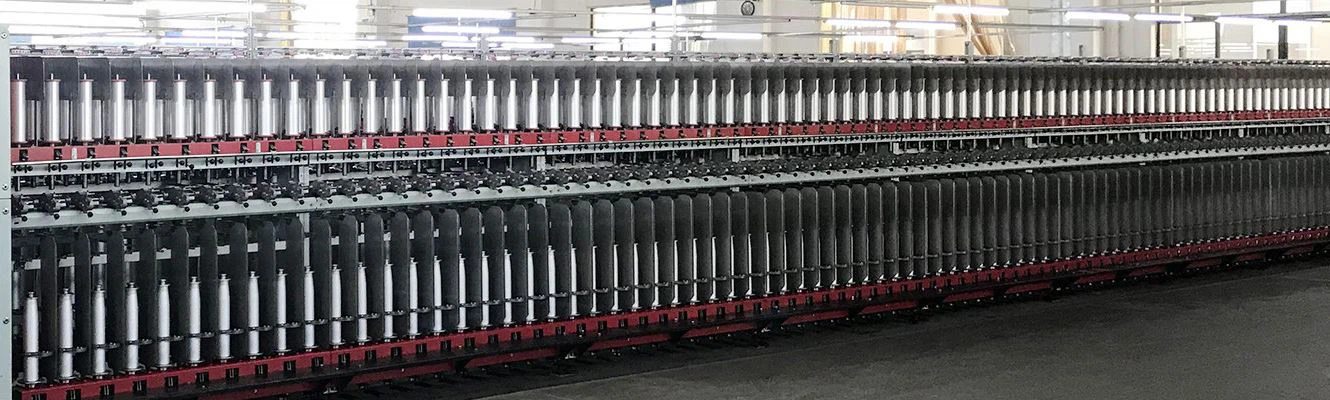


Industrial Filament Sewing Thread Double Twister Machine
DT2005 Precision CNC Composite Twisting Machine
industrial filament sewing thread double twister machine
The finished yarn can reach the highest international quality standards and can be produced to some high value-added products. We can also undertake various kinds of processing business such as embroidery thread, knitting yarn, zipper, luggage lines etc according to clients’ requirement. If you need some kind of thread and yarns, not machine, you can also call us and tell us you requirements about thread or yarns and we will produce it in accordance with your demand.industrial filament sewing thread double twister machine
High Quality Yarn
Winch roller driven by single spindle, more accurate yarn twist, no external force extrusion, more rounded cross section;
Display of computer tracking on spindle speed, ensure accuracy of both initial and compound twist;
No oil imported materials of high speed steel making, less breakage;
NC constant tension winding, ensure constant thread speed, volume weight up to 1.6kg.
Ply Count Range:
2×1: 50D—500D
3×1: 50D—1000D
Products apply for sewing, embroidery, bonded thread.
industrial filament sewing thread double twister machine
Spindle arrangement | 2×1 | 3×1 | |
Supply spindle NO. (1section) | 36 | 40 | 36 |
Ring spindle NO. (1section) | 18 | 20 | 12 |
Supply spindle NO. (10section) | 360 | 400 | 360 |
Ring spindle NO. (10section) | 180 | 200 | 120 |
Main Technical Date:
Twist range | 650 to 1250t/m, 3 to 32t/inch |
Twist direction | S or Z changeable |
Assemble ends | 2-4 |
Ring | Φ115mm Φ140mm |
Max.winding height | 330mm |
Spindle driving | Tangential bel driving |
Start mode | Stepless speed controlled by inverter |
Take-up spindle gauge | 2×1 162mm 180mm 3×1 270mm |
Spindle speed | 6000-7500rpm |
Take-up bobbin capacity | 2×1 1.1kg 3×1 1.6kg or 2kg |
Max.installed power | 16.1kw |
Overall Size | L×W×H=18.84M×1.10M×1.80M |


Textile industry related information
industrial filament sewing thread double twister machine
3. Trade and investment policies
Foreign trade policy
Nigeria has signed bilateral trade agreements with 16 countries including China, Cuba, Egypt, Ethiopia, Iran, Kenya and Vietnam. The Nigeria US trade and investment framework agreement signed with the United States has also officially entered into force. In terms of unilateral preferential trade arrangements, Nigeria enjoys the trade preferential policies granted by the EU Cotonou agreement and the African Growth and Opportunity Act (AGOA) of the United States. Multilaterally, Nigeria is a member of the economic community of West African States (ECOWAS) and the global system of trade preferences (GSTP) for developing countries, and is also a party to the free trade agreement on the African continent.
Nigeria adopts tariff escalation to encourage its industrial and agricultural production. The import of basic raw materials and means of production (including production equipment) for production shall be subject to low tariffs, and the import of industrial finished products, food, consumer goods and luxury goods shall be subject to high tariffs. The import tariff of most textile raw materials such as raw silk, wool and flax is 15%, that of cotton is 5%, that of cotton thread and yarn is 30% ~ 40%, and that of finished products and garments is more than 55% ~ 75%. Second hand clothing has been banned from import by the Nigerian government since 2010.
Preferential investment policies
Nigeria has signed bilateral investment agreements with 15 countries and regions such as China, Finland, Spain, Italy, Germany, Romania and South Korea, which have come into force. According to the relevant provisions of the Nigerian Investment Promotion Commission Act, Nigeria implements a unified preferential policy for foreign investment without double standards. For 69 subdivided industries / products including manufacturing, pioneer status can be granted. Enterprises investing in pioneer industries can enjoy a 5-year tax holiday and 7-year tax holiday in economically backward areas. The production of cotton yarn and man-made fiber belongs to one of the above pioneer industries. In addition, Nigeria's preferential investment policies include:
(1) Labor intensive enterprises can get tax relief. For example, enterprises employing 1000 or more people can enjoy 15% tax preference; Enterprises employing 200 or more people can enjoy 7% tax preference; Enterprises employing 100 or more people can enjoy a tax preference of 6%.
(2) Manufacturing enterprises in the bonded area shall enjoy tax exemption when importing raw materials and intermediate products for re export production;
(3) Enterprises who import raw materials and then export them after production enjoy a 60% tax rebate;
(4) Export enterprises earning foreign exchange enjoy export subsidies with relevant certificates;
(5) The government set up an export development fund to provide initial cost support for private export enterprises;
(6) Enterprises in the economic cooperation zone can enjoy many preferential policies, such as exemption from taxes and fees of governments at all levels, tariffs on imported raw materials, value-added tax and other relevant taxes; The capital stock invested by foreign capital can be withdrawn at any time; Visa quota is not restricted; Products can be freely sold all over the country and 24-hour power supply; One stop service; No strike and other preferential policies are allowed in the park.
Hot Tags: industrial filament sewing thread double twister machine, China, manufacturers, suppliers, factory
You Might Also Like




Send Inquiry