

Because of the various aspects of China-US trade and the economic environment, the textile trade in 2019 has been greatly declining compared with the previous two years, especially the US single, which is half of the last year. Everything is common." This year is nearing the end, and the market is basically a foregone conclusion. The rest is more finishing work. Therefore, textile people are more concerned about the foreign trade market next year. The good news that has recently been sent out may allow us to vaguely glimpse some of the signs of next year's market.
The US market is expected to be unblocked: the tax codes for 15 textile and apparel products are excluded!
The Chinese Ministry of Commerce recently stated that China and the United States have agreed to phase out the increase of tariffs in the past two weeks. On November 7th, US local time, the Office of the US Trade Representative (USTR) announced the product exclusion announcement under the fourth batch of 200 billion US dollars plus tariff items. This exclusion involves 36 products, including 3 textile and apparel products. Tax number.
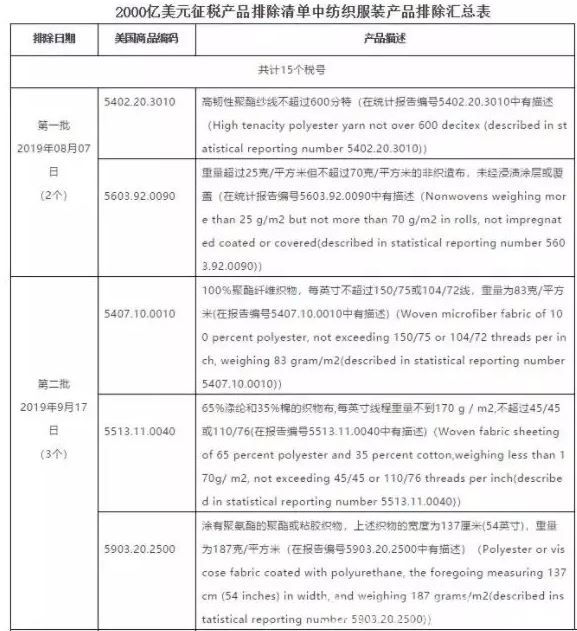
Up to now, the US has released four batches of 200 billion product exclusion lists, of which the first batch involves two textile and apparel products tax numbers, the second batch involves three textile and apparel products tax numbers, and the third batch involves seven textile and apparel products tax numbers. A total of 15 textile and apparel products tax number. Excluded products will no longer be subject to a 301 tariff when they are exported to the United States. The exclusion period can be traced back to the effective date of the 200 billion list - September 24, 2018. The excluded products listed in this announcement are valid from September 24, 2018 to August 7, 2020.
In past research, textile bosses almost agreed that the increase in tariffs caused by Sino-US trade wars is the main reason for the “cold encounter” in the textile foreign trade market this year.
For the textile boss, the tariffs imposed by the United States are “small and moving”, and some weaving companies do not export themselves, but downstream fabrics, clothing, and luggage companies purchase their products for processing and export. But now 25% or even 30% of the tariffs are unbearable in the production, processing and circulation of the products, and the profits of the terminal retails that make up the profits are not available to Chinese weaving companies.
As far as Xiaobian learned, after the sudden increase in taxes in the United States, many foreign trade companies were returned by the US because of the “unnecessary” reason for the order transaction, which caused huge losses to Chinese enterprises. To a large extent, it has hit the confidence of the market.
Now China and the United States have gradually phased out the tariffs imposed on them. Many of the orders that can't be done now will be implemented. The situation of the US singles will be greatly relieved.
Good news from the Southeast Asian market: RCEP signs next year, China's textile exports may reverse
On the evening of November 4th, the leaders of the 10 ASEAN countries and China, Japan, South Korea, Australia, New Zealand and India issued a joint statement after the meeting, saying that in addition to India, the 15 countries of the Regional Comprehensive Economic Partnership Agreement (RCEP) All text negotiations and virtually all market access negotiations have been completed and are ready to be signed next year.
As is known to all, Southeast Asia is currently the fastest growing emerging market in the textile industry. In recent years, both textile imports and exports have grown rapidly, while Japan, South Korea, Australia and New Zealand are also important textile exporters in China.
Today's Southeast Asian textiles have sufficient labor advantages, but the infrastructure and technical level are weak. Once the agreement is signed, the complementary advantages of the textile industry in China and Southeast Asian countries will be more obvious. China's textile raw materials, grey fabrics and fabrics can be lower. The cost is shipped to Vietnam, Malaysia and other places for processing, using the local labor advantage to make garment exports.
For developed markets such as Japan, South Korea, Australia, and New Zealand, after the establishment of RECP, textile export tariffs are further reduced, and Chinese textiles will be more competitive than they are now.
During the visit, the cloth boss generally expressed a dissatisfaction with this year's market, but also felt that the probability that such a market has continued will not be high. Indeed, the "cold winter" of textile export this year is caused by a combination of factors, and more is an occasional discovery. With the accelerated transformation and upgrading of China's domestic textile industry and the development of foreign trade emerging markets, next year's textile trade may be able to Get more opportunities and turn around this year.
Affected by various factors, this year's textile foreign trade market is "cold". However, there are already many signs that the foreign trade situation next year may be improved to some extent this year. Even so, the international situation is changing rapidly. Today, if Trump can't reach an agreement, the United States will increase the threat of tariffs. The current situation of Sino-US trade has become confusing. The market will still be very big next year. Certainty, but in short, the most difficult moment has passed, and in the future, textile companies can neither lose confidence nor prepare in advance.


